

Endodontics & Root Canal Treatment in Berlin Mitte
Root Canal Treatment & Endodontics
We work under a surgical microscope. Some root canals are finer than a hair and branch out all the way to the tip of the root. Without magnification, it is easy to miss something there.

Where are you right now?

I am in pain
Just give us a call. We will listen to what is going on and find an appointment for you.

I have been advised to have a root canal treatment
Then you may not yet know what to expect. Further down, we explain step by step how we proceed.

My root canal treatment hurts again
That does not necessarily mean the tooth is lost. With a second treatment it can often still be saved.

I would like to refer a patient
You would like to send someone to us for endodontic treatment? Here is how we work together.
When a tooth throbs at night
Inside every tooth lies the pulp, a tissue made of nerves and blood vessels. If bacteria reach it, it becomes inflamed.
The way in is opened by deep defects in the hard tooth structure, usually caused by decay or a fractured tooth. Bacteria also travel into the tooth beneath leaking crowns, inlays or fillings.
The inflammation is often very painful and causes the nerve tissue to die. How quickly that happens cannot be predicted. Sometimes symptoms appear only years after a filling.
Typical signs are
- throbbing or pulsating pain, often worse at night
- a tooth that reacts to cold or heat for an unusually long time
- sensitivity to pressure when biting
- swelling of the gum next to the tooth
An inflammation does not have to hurt, though. We often discover chronic cases by chance on an X-ray. Left untreated, the bone around the root tip keeps breaking down. At some point it turns into an acute inflammation.

How a root canal treatment works in our practice
We complete most treatments within one to one and a half hours. One appointment is often enough.
01 Anaesthesia
Before we start, we numb the tooth. If you like, we add nitrous oxide.
02 Core build-up
If the old filling is leaking, we replace it first. Otherwise we would be rinsing against bacteria that keep coming back.
03 Rubber dam
Then we stretch a thin sheet over the tooth. It keeps saliva away and catches rinsing solution and small instruments.
04 Shaping
Now we clean every canal all the way down to the root tip. This part takes its time.
05 Disinfection
We rinse the canals with a disinfecting solution. Ultrasound carries it into the finest lateral canals.
06 Sealing
Finally, we fill the canals and seal the tooth tightly. No bacteria can get back in.
In cases of severe inflammation we need two to three appointments. In between, we place a medication inside the tooth and seal it temporarily. Because a root-treated tooth breaks more easily, we usually recommend a crown or partial crown afterwards.
What we see under the microscope
Microscopic endodontics means that we check every step of the work under magnification. The entrances to the root canals are tiny and sometimes hidden. At 25x magnification we look all the way down to the root tip and find canals that would otherwise go undetected.
The magnification also helps with problems left over from earlier treatments. We seal deep perforations under direct vision. Broken instruments we usually retrieve rather than giving up on the tooth.
If a root is particularly curved, we additionally take a 3D X-ray to assess the anatomy of the tooth in three dimensions beforehand.
Our endodontic services
Everything about saving your tooth in one place

Revision root canal treatment
Sometimes a root canal treatment does not last. Then we clean the canals again and seal them anew.

For referring dentists
You refer patients to us for endodontic treatment? Here you will find our workflow and everything about sending findings.

3D X-ray diagnostics
When roots take an unusual course, a three-dimensional image helps. That way we know the anatomy before the treatment.

Nitrous oxide for dental anxiety
If you feel tense before your appointment, nitrous oxide can help. You remain responsive but relax nonetheless.
Your endodontist in Berlin Mitte
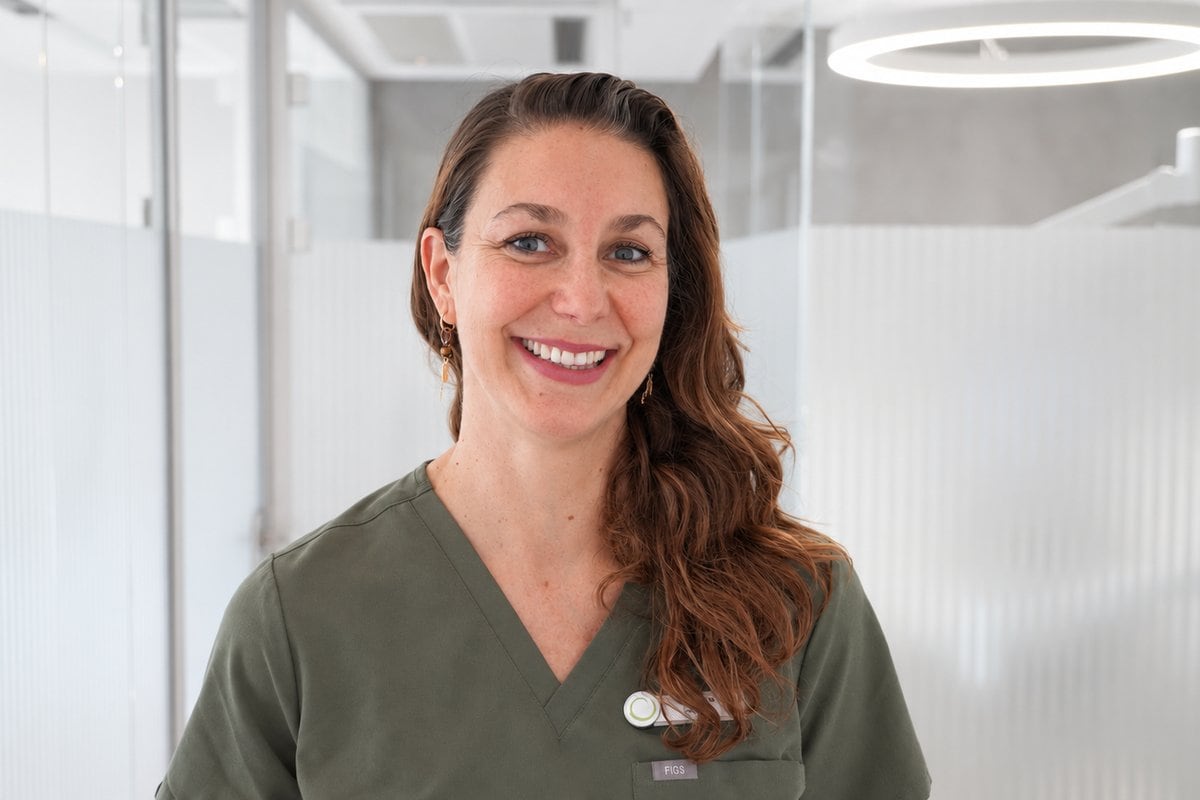
Adisa Keita, M.Sc. Endodontics
Adisa Keita specialises in endodontics. After qualifying at Charité Berlin in 2008, she worked in several Berlin practices with a focus on root canal treatment under the surgical microscope. She completed the Curriculum Endodontics at the Philipp Pfaff Institute in 2013 and a Master of Science in Endodontics at Danube Private University in Krems in 2023. From 1 October 2026 she takes over root canal treatments in our practice, together with her colleague Magdalena Cukier.
If your own dentist has referred you to us, we coordinate closely with their practice. After the root canal treatment, your care continues where you are used to it. You are of course also welcome to contact us directly without a referral.
Will the tooth really last?
The prognosis is better than many expect. The German Society for Conservative Dentistry (DGZ) puts the success rate of an uncomplicated first treatment at up to 95 percent, and of retreatments at over 80 percent.
Results like these are only possible with a microscope, rubber dam and thorough disinfection. That is why we place so much importance on them.
What the treatment costs and what your insurance covers
How much a root canal treatment costs depends on the effort involved. A front tooth with one canal is quicker to treat than a molar with four. A severe inflammation takes extra time.
German statutory health insurance covers root canal treatment if the tooth is considered worth preserving under its guidelines. Anything beyond that, such as working under the surgical microscope, is billed privately.
Before we start, you receive a cost estimate from us. You will know what to expect.
Frequently asked questions about root canal treatment
What patients often ask us
Our services in Berlin Mitte
All dental services at a glance

Crowns & Bridges
Fillings & Inlays
Implants

Root Canal Treatments
Orthodontics

Dental Aesthetics

Professional Teeth Cleaning

Teeth Whitening
Periodontitis Treatments

TMD / Night Guards

